Te Tokotoru Tapu: a local landmark
- by Jim Peters
Thank you to Lynette Penrose & whanua for assistance and advice in writing this piece.
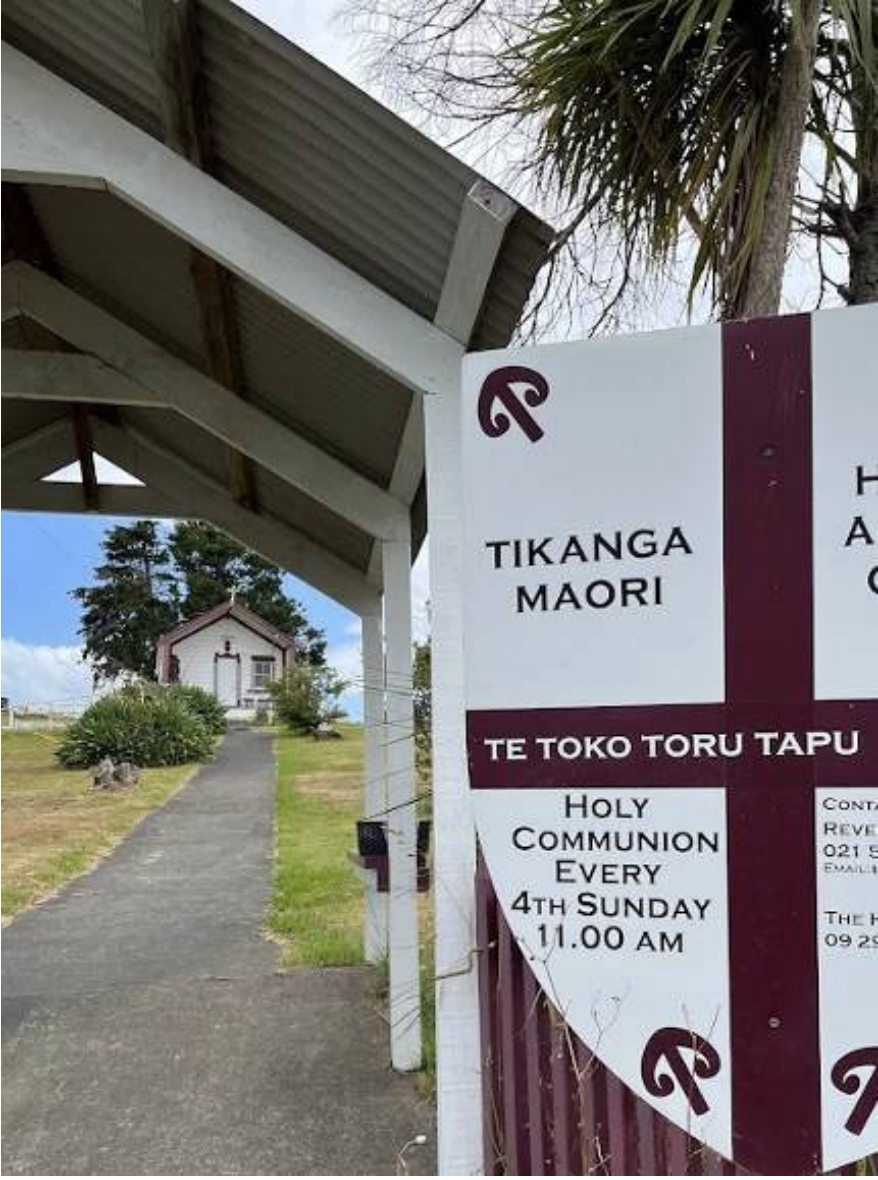
Travel the road between Clevedon and Kawakawa Bay and you pass through Mataitai, the ancestral home of Ngati Kohua. Perched above the road at Mataitai you see the distinctive Te Tokotoru Tapu Church and it’s surrounding urupa (cemetery). It’s a local landmark with an interesting history. The story of Te Tokotoru Tapu – which translates to ‘The Church of the Holy Trinity’ - goes back to 1910 when Rahera Titia i te Rangi Paraone (Brown) and her whanau moved from the Coromandel to Mataitai to be close to her father, Rewiti Whakahihi Tamatea, and live on the whenua (land) of her ancestors.
The Paraone whanau settled firstly in a raupo whare at Poutu Point, near to where Rewiti lived, before building a modest wooden house on the flats near the present location of the church.
It was in that house where the possibility of building a whare karakia (church) was first mooted. This led to the transferring of land to the Anglican Diocese of Auckland for the building of a church. The Memorandum of Transfer shows that “Rewiti Whakahihi” authorised the transfer of a half acre (or “two roods” in the deed speak of the time) of land for the sum of five pounds.
The cost of building the church was met by donations made by both Māori and Pakeha. Timber for the construction was transported from Auckland by scow, dropped off at a tidal creek near where Clevedon Coast Oysters is situated today, and taken on to the building site, a further mile or so away, by horse drawn wagons. The building was done by voluntary labour from the community and completed in early 1912. On the 5th of June the official opening and naming of the new church was performed by the Bishop of Auckland, the Rt Rev. O.T.L. Crossley in the presence of a large gathering of Māori and Pakeha.
Te Tokutoru Tapu has considerable significance, both locally and nationally. It was the first Anglican Church to be carved and the second to be built in the traditional form of a wharenui (meeting house). Throughout it’s life of 114 years there have been changes in the structure, but it remains a landmark for the community of Clevedon and, through its faith, has facilitated the coming together of Māori and Pakeha.
The urupa that surrounds Te Tokotoru Tapu is also a place of deep spiritual tradition. In addition to the marked graves of the deceased, it contains unmarked remains that are tapu and should not be disturbed. The eastern side is reserved for descendants of Paraone whanau, the western side is reserved for other parishioners.
Today Te Tokotoru Tapu and its land is owned by The General Trust Board of the Diocese of Auckland. Care and maintenance are carried out by the descendants of Rewiti Whakahihi and the Paraone whanau, as well as those with connections to the urupa.
Te Tokotoro Tapu continues to function as a church every 4th Sunday of the month.
Kia mau ki te tūmanako, te whakapono me te aroha. Hold fast to hope, faith and love.